How It Works
How Negative Ions Freshen Enclosed Spaces
A plain-language explanation of negative ions and how negative-ion technology is used in portable purifiers for cars, offices, and small rooms.
Negative ion technology shows up in a lot of product descriptions — car purifiers, desk fans, hair dryers, even some air conditioners — but the explanations are often either overly technical or vague marketing language that does not really explain what is happening. This article breaks the concept down in plain language: what negative ions actually are, where they occur naturally, how portable purifiers generate them, and what this kind of technology can and cannot reasonably be expected to do in an enclosed space like a car cabin, office, or bedroom.
We will also look at how this technology is used in a product like the PureCabin™ FreshDrive, while being clear about the limits of what any portable purifier — negative-ion or otherwise — should be expected to do.
What is a negative ion, in plain language?
Air is made up of countless tiny particles, and some of those particles carry a slight electrical charge — positive or negative. A "negative ion," in the context of air purification, generally refers to an air molecule that has picked up an extra electron, giving it a negative charge. This happens constantly in nature through processes like moving water, sunlight, and friction between air particles, and it also happens artificially inside small electronic devices designed to generate charged particles on purpose.
The basic idea behind negative-ion air technology is that these charged particles interact with other particles floating in the air — dust, pollen, and other tiny airborne material — causing some of them to clump together and settle out of the air more quickly than they otherwise would. This is a physical, electrical process, not a chemical reaction, and it is different from how a traditional filter works, which physically traps particles as air passes through a material like paper, foam, or fiber.
Where do negative ions occur naturally?
Many people report feeling like the air is "fresher" near a waterfall, after a thunderstorm, or at the beach with waves rolling in. These environments are often cited as having naturally higher concentrations of negative ions, generated by moving water and atmospheric electrical activity. This is part of why negative-ion technology is sometimes described as recreating a small piece of that "fresh air after rain" feeling indoors or in a vehicle — though it is worth being cautious about how far that comparison should be taken, since a small electronic device and a coastal storm system are obviously very different in scale.
How negative-ion generators work inside a portable purifier
Inside a compact purifier, a small internal component generates a stream of negatively charged particles and releases them into the surrounding air, typically through a vent or grille on the unit's housing. As these particles disperse into an enclosed space — like a car cabin, a small office, or a bedroom — they interact with airborne particles nearby. In products that combine this technology with a physical composite filter, air is also drawn through the unit so that some particles can be captured directly, combining electrical and physical approaches in the same device.
This is a low-power process, which is part of why negative-ion generators are well suited to small, USB-powered devices. It does not require the larger motors or higher airflow rates that some traditional whole-room filtration systems use, which is one reason this technology is common in compact, personal-space purifiers rather than industrial air-handling equipment.
What negative-ion purifiers can — and cannot — reasonably do
It is important to be direct here: negative-ion technology is not a medical treatment, and no portable purifier — negative-ion or otherwise — should be marketed or understood as one. Reputable products describe this technology in terms of freshening the air in an enclosed space, not in terms of preventing or treating illness, allergies, or any medical condition. If you have ongoing respiratory or health concerns related to air quality, that is a conversation for a medical professional, not a product description.
What negative-ion technology is reasonably understood to do, based on how it works physically, is support the general freshness of an enclosed space by helping some airborne particles settle out of the air more quickly, especially when combined with a composite filter and used as part of a broader routine that includes ventilation and cleaning. It is one tool among several, not a standalone solution to every air-quality concern.
Negative ions in cars, offices, and other small spaces
Small, enclosed spaces are actually a reasonable setting for this kind of low-power technology, precisely because the volume of air being treated is limited. A car cabin, a desk area, or a small bedroom is a much more contained environment than an open living room or a warehouse, so a compact generator has a more realistic chance of having a noticeable presence in the surrounding air.
This is part of why portable negative-ion purifiers are commonly marketed for cars, desks, and small rooms up to roughly 10m² (about 100 square feet) rather than for large, open, or multi-room spaces. Matching the technology and the device's rated coverage to the size of the actual space you intend to use it in is one of the most important — and most overlooked — parts of getting a useful result from any portable purifier.
A brief history of negative-ion technology in consumer products
Interest in ionized air dates back over a century, with early researchers studying how charged particles in the atmosphere appeared to correlate with how "fresh" people described certain environments, like mountain air or the area near moving water. Consumer devices built around this idea became more common starting in the latter half of the twentieth century, initially as standalone room ionizers, and later as a feature integrated into fans, humidifiers, and eventually compact portable purifiers as miniaturized electronics made small, low-power ion generators practical to build into pocket-sized devices. The technology used in a modern USB purifier is a direct descendant of that same basic principle, scaled down to fit a device that runs on a few watts of power.
Common misconceptions worth clearing up
"More ions always means more effect"
Ion output is only one variable among several that determine how noticeable a device's effect is in a given space. The size of the room, how enclosed it is, existing ventilation, and how long the device runs all matter as much as the raw ion count a manufacturer might advertise. A small device used consistently in a small, enclosed space like a car cabin is often a more sensible match than a similarly small device used in a large, open room.
"Ionizers and ozone generators are the same thing"
These are related but distinct technologies. Ozone generators intentionally produce ozone gas, which has its own safety considerations and recommended exposure limits. Negative-ion generators are designed to charge air particles without deliberately producing ozone as the primary output. Reputable consumer products are designed and tested with this distinction in mind, and it is a reasonable question to ask about any ionizing device before buying it.
"If I can't smell a difference, it isn't working"
Smell is a very limited way to judge air quality — many airborne particles have no odor at all, and the electrical process behind negative-ion generation is not something most people can perceive directly. A more reliable way to think about a purifier's role is as one consistent, low-effort layer in a broader routine, rather than expecting an immediate, dramatic, and directly perceptible change every time it runs.
Combining negative-ion purification with good habits
Whether you are using a purifier in a car, an office, or a bedroom, the same basic principles apply. Ventilate the space periodically when practical — even a negative-ion purifier benefits from some exchange of air rather than working against a completely sealed room. Clean regularly, since dust, crumbs, and spills are physical sources of odor and particles that no purification technology can fully substitute for removing directly. And maintain any physical filter in the device on the manufacturer's recommended schedule, since a combined ion-and-filter system depends on both parts working as intended.
How FreshDrive uses negative-ion technology
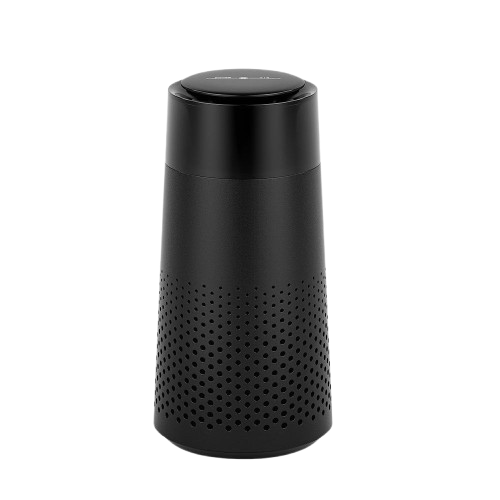
The PureCabin™ FreshDrive combines negative-ion technology with a composite filter in a single compact, USB-powered unit. It is designed for personal-space use — a car cabin, a desk, or a small room up to about 10m² — and runs quietly below 36dB with roughly 50m³/h of air movement, so it can operate continuously in the background without becoming a distraction. Touch controls keep operation simple, and the ABS housing is available in four variants — White, Black, White Pro, and Black Pro — each priced at $24.99 USD with free shipping.
As with the explanation above, FreshDrive is presented as a tool for helping freshen enclosed air as part of a broader routine — not as a medical device, and not as a replacement for ventilation, cleaning, or a vehicle's own cabin air filtration system.
Questions worth asking before buying any ionizing purifier
If you are comparing negative-ion products beyond FreshDrive, a few questions are worth asking of any manufacturer. Does the product specify a noise level, and does that number match how you intend to use it — in a quiet office, a car, or overnight in a bedroom? Is the stated coverage area realistic for the space you have, or is it based on an idealized, fully sealed test chamber that will not match real-world conditions? Does the product combine ion generation with a physical filter, or rely on ionization alone? And critically, does the marketing avoid medical claims, or does it lean on vague health promises that a legitimate consumer electronics product should not be making? Asking these questions consistently will help you evaluate any negative-ion product on its actual merits rather than on marketing language alone.
Frequently asked questions
Can I feel or see negative ions working?
No — negative ions are not visible, and most people will not directly "feel" the ionization process itself. Any perceived difference in air freshness is more likely tied to the overall combination of ventilation, filtration, and reduced particle buildup in a space over time, rather than a sensation from the ions themselves.
Is negative-ion technology the same as an air filter?
No. A filter physically traps particles as air passes through a material. Negative-ion generation is an electrical process that encourages some airborne particles to clump and settle. Many products, including FreshDrive, combine both approaches in one device.
Does this technology treat allergies or respiratory issues?
No. Negative-ion purifiers are not medical devices and should not be used as a substitute for medical advice or treatment. If you have specific health concerns related to air quality, speak with a qualified medical professional.
Negative-ion technology is a genuinely interesting piece of everyday engineering, but it works best when understood realistically — as one part of a broader approach to freshening small, enclosed spaces, alongside ventilation, cleaning, and regular filter maintenance. For more explainers like this, visit our blog, check the FreshDrive FAQ, or review our shipping policy and refund policy before ordering. Learn more about the company on our about page, or reach out through our contact page with any questions.
This article is provided for general educational purposes. It does not provide medical advice, and no statements here should be interpreted as claims that negative-ion technology treats, cures, or prevents any illness or medical condition.
PureCabin FreshDrive
Fresher cabin air from $24.99
USB-powered · Quiet under 36dB · Free shipping · Secure Stripe checkout